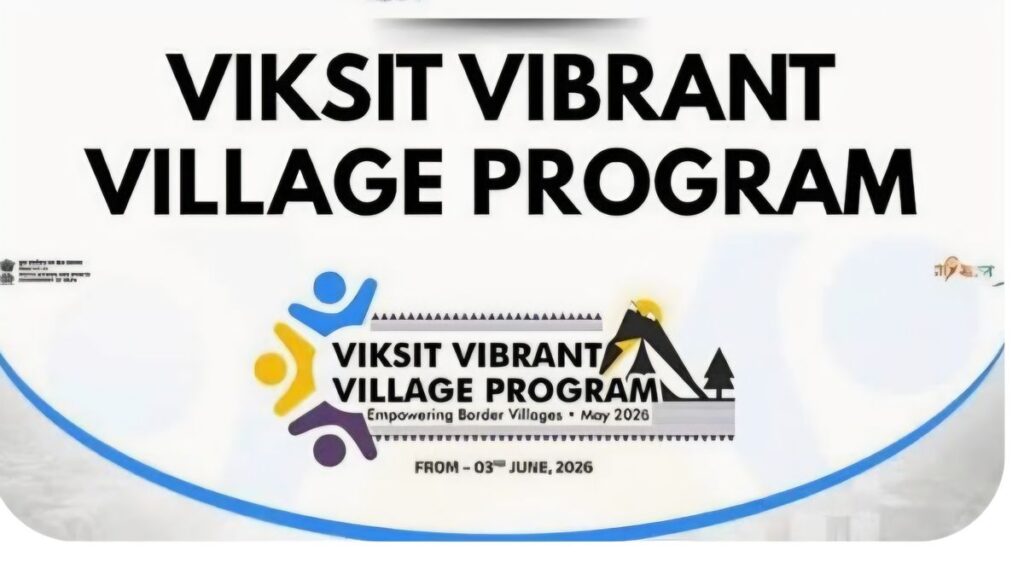
The Prime minister’s recent exhortation during his address to youth of the country on the eve of ‘Developed India young leader’s dialogue’ with his seminal message that the sole objective of VVV( Viksit vibrant village) programme was to lead the youth of the nation towards border villages and live with local communities is well intentioned. But then here ends all these exhortations when converted to actuals.
The honourable PM’s call for the youth to delink themselves from the virtual world, step into the ground and connect themselves with the locals of the border areas is all a feel good factor that is bound to rub into all of us sooner or later. Interacting with the participants, many of whom belong to Gen Z, of the VVP programme -2026 that covered 74 ‘vibrant villages’ across Ladakh, HP and Uttarakhand , PM Modi said in the country’s border villages , the aspiration for development and the spirit of patriotism are equally cherished.
At times, it feels that for these people the country matters more than themselves. The PM further said that during ‘DIYLD (Developed India young leaders dialogue), he had presented an idea before the youth. ‘The idea was that why not have the youth, instead of using virtual medium to step onto ground to know India, connect with India, try to live India and understand India’. All very lofty ideas indeed.
Yet an important question deserves attention: Is merely encouraging young people to visit border villages enough? Should public policy stop at promoting tourism , or should it go a step further by encouraging India’s youth to live, work, innovate and build livelihoods in these villages? At first glance, the appeal appears inspiring and patriotic.
However when viewed through the prism of strategic realities, demographic trends and national security, the appeal seems more symbolic than substantive. It reflects an idealistic vision that is disconnected from the hard realities confronting India’s border villages. The challenge facing India’s frontiers is not that the rest of the country has failed to admire them. Rather the people who live there are slowly leaving these border villages for greener pastures deeper in the hinterland of India.
A border village doesn’t become vibrant because some college students (Gen Z) spend a weekend taking photographs, interacting with the locals and posting patriotic messages on the social media, all on behest of PM Modi’s exhortations. Further giving an example, the PM said that several years ago the creation of ‘MY Bharat’ platform provided millions of youth from across the country to connect with such far flung areas of India. His abiding opinion being—to dovetail this VVV programme within the ‘My Bharat’ platform as also to treat these border villages as the ‘First Indian village’ rather than as ‘Last Indian village’ as had been the norm few years back.
Indeed promoting tourism without addressing structured deficiencies risks confusing visibility with vitality. Increased footfalls of youth of India on PM’s exhortation to border villages may generate seasonal income for a handful of households, but it does not create stable economic ecosystems required to retain an entire generation. Tourism by nature is seasonal, population stability is permanent.
As if this was not enough, already many border villages of Ladakh, HP and Uttrakhand have earned the dubious moniker of ‘Ghost villages ’or ‘Bhutia Gaon’ for the simple reason that they have been abandoned by the dozens by their residents for lack of opportunities, better jobs, good medical infra , virtual absence of industry infrastructure and so on. This brings me to my most important question for the readers of Rising Kashmir paper in this write up of mine. Why start rolling out VVV/VVP programme when for decades India has/had the well-established BADP (Border area development programme ) in place? Is it not duplication of effort for the same stated objectives by the government of the day?
A little research and the distinction springs out clearly why VVV/VVP has been ruling the roost in the recent past vis-a vis the BADP. The VVV/VVP was kick started alongside the BADP because latter suffered from spread-out funding and generalized execution, whereas the VVV/VVP provides targeted, intensive and strategically focused development to stop out-migration in vital frontier hamlets. BADP faced implementation slowdowns , delayed UC’s ( utilization certificate) and so on. BADP relied on broad, state level and district level allocation of funds across a 0 to 10 kms border radius, while VVP uses a granular, village level cluster approach to achieve 100% saturation of basic amenities.
At the same time VVP/ VVV specifically incentivizes residents to stay in remote depopulated frontier areas by building local economies , tourism and cultural connectivity, transforming ‘last villages’ into strategic ‘first villages’. Unlike traditional schemes, VVV/VVP phases real-time, data driven response to economically anchor strategic frontier populations and build comprehensive economic drivers, moving past conventional infra checklists. This brings me to my next important question—Was/is BADP a failure that promised a lot but delivered far short of expectations of both the governments of the day as well as the border populace? Let the readers of this write up of mine decide.
It will be worth noting for the readers of Rising Kashmir paper that the VVV/VVP has been an Indian response to China’s model villages that have sprung up all along the LAC in the last few decades. As stated above, China over the past two/three decades has systematically integrated its civilian development with its national security objectives through what it calls ‘Civil-military fusion’ (CMF). Under this strategy, infrastructure, economic development, technological advancement and civilian settlements are closely aligned with broader national cum strategic goals. It is no secret that along the Tibetan frontier and other sensitive border regions , China has invested heavily in model villages ,all weather roads, high speed communications ,healthcare facilities, renewable energy ,schools, and economic incentives designed to encourage civilian habitation. Many of these settlements are dual-purpose in character.
While they function as ordinary villages, they simultaneously strengthen logistical support, surveillance capability and territorial assertion. China’s approach is not driven by symbolism. It is driven by strategic permanence. Its border villages are intended to be lived in –not merely visited.
India’s bane since independence towards such issues has always been couched in symbolism—as was evident during our so called ill-fated ‘Forward policy’ enunciated by the trio of Nehru, Menon and BN Mullick the then IB Chief in the 50s &60s. Whether one agrees with China’s political system is entirely beside the point. Democracies need not emulate authoritarian governance. However they cannot afford to ignore strategic lessons where national interests override petty local issues of governance.
It is not that the past governments of India since independence brushed aside these issues with disdain, rather the first PM Nehru way back in 1951 had commissioned the then Dy Defence minister Maj Gen Himmat singhji to tackle this border area development. The committee, then known as ‘North and North East border defence committee’, put forward its valid recommendations that were followed through too in a later time frame. But as is the wont with a democratic country, the changing dispensations at Delhi since independence followed their own manifestoes.
China has pursued ‘demographic consolidation’ as an integral element of its border strategy through its CMF theory. India need not jump into the fray to emulate China’s Geo-political model, but at the same time it would be grossly out of step for us to ignore all too important frontier population of our country that is slowly eroding at the altar of modernity and dazzling lights of our metros. Ultimately VVV will be carried on the shoulders of robust policy planners sitting at Raisina hills who should swap the ‘air of symbolism’ with that of actually dirtying their hands with ground realities as existing from Ladakh to NE.
(The writer is a retired army officer and a regular scribe of Rising Kashmir. He can be approached on his [email protected])
var fbKey = ‘174123585737091’;
(function(d, s, id){
var js, fjs = d.getElementsByTagName(s)[0];
if (d.getElementById(id)) {return;}
js = d.createElement(s); js.id = id;
js.defer = true;
js.src = `https://connect.facebook.net/en_US/sdk.js#version=v2.2&appId=${fbKey}&status=true&cookie=true&xfbml=false`;
fjs.parentNode.insertBefore(js, fjs);
}(document, ‘script’, ‘facebook-jssdk’));