Indians appear increasingly impatient with the way institutions function, more suspicious of whether the system is fair and less willing to give governments the benefit of the doubt when things go wrong. Yet they continue to support several ideas central to the Narendra Modi-led Union government’s political agenda—the Uniform Civil Code; One Nation, One Poll; and the push against illegal immigration.
That is a key message from the india today Mood of the Nation survey conducted in August 2026: a crisis of trust is developing beneath a remarkably resilient political consensus.
That uneasy mix is already visible on the streets. The Gen Z-led agitation against the National Eligibility-cum-Entrance Test (NEET) paper leak that began at Jantar Mantar gathered enough momentum to force Union education minister Dharmendra Pradhan to resign. The anger then travelled. Jharkhand saw thousands of young people protesting alleged irregularities in recruitment examinations, followed by a similar confrontation with the authorities in Bihar. And within weeks of the NEET agitation, Jantar Mantar was again occupied, this time by people demanding changes to caste-based reservation. These are different protests with different politics, but they are connected by a growing suspicion among young Indians that the gateways to education, jobs and upward mobility are neither predictable nor fair.
That anxiety is most clearly visible in answers to the question about the state of democracy. In January 2026, 46 per cent of respondents said democracy was not in danger, compared with 44.7 per cent who believed it was. Seven months later, the positions have reversed: 46.7 per cent now believe democracy is in danger, while 41.6 per cent say it is not. This is not the first time the ‘danger’ figure has exceeded the ‘not in danger’ figure. It also happened in August 2025 and in several earlier surveys. But the improvement recorded in January has now all but disappeared.
More worrying is the steady erosion in confidence that elections are free and fair. A year ago, in August 2025, 64.4 per cent of respondents said they were. That fell to 56.5 per cent in January and has now dropped to 51.9 per cent. Over the same period, the share of those who believe elections are not free and fair has risen from 31.7 per cent to 40.9 per cent. This is perhaps the most significant institutional warning in these findings.
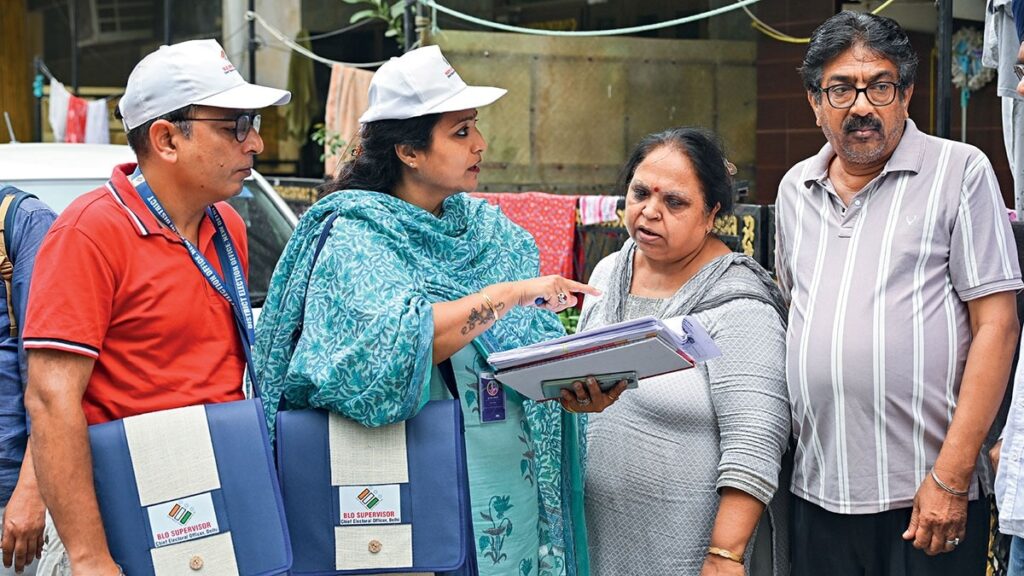
And yet voters are not buying every argument made against the Election Commission. Asked directly about trust in the EC over the past year, 43.3 per cent say it has increased and 38 per cent state the opposite. On the Special Intensive Revision (SIR) of electoral rolls, an emphatic 60.2 per cent believe the exercise was necessary to remove bogus or duplicate voters. The message is clear: voters can worry about electoral fairness without accepting the Opposition’s entire narrative.
There is another notable reversal: over the misuse of enforcement agencies. In January, 47.7 per cent said governments of all political parties misuse agencies such as the Enforcement Directorate (ED), Central Bureau of Investigation (CBI) and Income Tax Department; 41.1 per cent specifically accused the Bharatiya Janata Party (BJP) government of doing so. Now the order has flipped: the BJP-specific figure has risen to 43.8 per cent; the other has fallen to 38.1 per cent.
At the same time, 54.1 per cent still say they feel free to express themselves on politics and religion, though that is down from 57.3 per cent in January. The picture, therefore, is not of a frightened society that believes it cannot speak, but of one becoming uneasy about how power is exercised.
FAITH FACTOR
The Ram Mandir donation theft shows how quickly a governance failure could damage a cornerstone of the BJP’s considerable social capital. Asked about the reported theft of offerings at Ayodhya, 46.6 per cent say it has negatively affected their view of both the Modi and Yogi Adityanath governments. Another 8.1 per cent blame only the Centre and 6.6 per cent only the Uttar Pradesh government. Taken together, 61.3 per cent say the episode has hurt their perception of at least one of the two governments.
The responses on caste-based reservations deserve equal attention, particularly after the latest protests. The largest cohort, 36.3 per cent, still occupies the middle ground: reservation, they believe, has some benefits but needs reform. But the more significant movement lies beneath it. The share wanting caste-based reservation abolished altogether has risen from 28 per cent in January to 32.2 per cent, the highest in the past three surveys. Meanwhile, the share saying reservation is necessary for social equality has slipped from 26.7 per cent a year ago to 23.9 per cent now, also the lowest of the three readings.
One way to read both the reservation and paper-leak protests is as expressions of a deeper anxiety among the youth over access to scarce opportunities—and whether effort still reliably translates into opportunity. That unease is also visible in how respondents judge the government’s record of delivery. In January, 24 per cent rated India’s roads and infrastructure ‘excellent’. That has fallen six points to 18 per cent. The combined ‘excellent’ and ‘good’ rating has dropped from 51 per cent to 45.6 per cent, the lowest in the past four surveys, while ‘poor’ and ‘very poor’ together have risen from 21.2 per cent to 25.2 per cent, the highest of the four readings. This matters because infrastructure has been one of the Modi government’s strongest and most visible claims to performance.
The ethanol question tells a similar story about the limits of top-down policymaking. Only 18 per cent want the current higher-blending policy continued without change, 35 per cent want safeguards and clearer guidance for potentially incompatible vehicles, while another 25 per cent want incompatible vehicles exempted altogether. In effect, 60 per cent want some change in policy.
QUIET SHIFTS
There are other revealing trends. On communal harmony, only 34 per cent now say it has improved under the BJP-led National Democratic Alliance (NDA) government, down from 39.6 per cent in January and matching the lowest level recorded since 2021. But the share saying the situation has ‘deteriorated’ has also fallen, from 32.2 per cent to 29.5 per cent. Where have respondents moved? Towards ‘remained the same’, which has climbed to 22.7 per cent, and those who are uncertain, whose figure has nearly doubled to 13.8 per cent. Rather than straightforward communal polarisation, the trend appears to be one of diminishing conviction that things are improving. Among those who see deterioration, the BJP-RSS remains by far the largest named reason, cited by 18.8 per cent of the full sample, although that figure too has fallen from earlier surveys.
Women’s safety shows a similar shift. The proportion saying India has become safer for women has fallen sharply from 44.1 per cent in January to 38.3 per cent. The ‘less safe’ figure has also declined, from 38.4 per cent to 33.8 per cent. Instead, ‘remained the same’ has jumped from 13.8 per cent to 21 per cent, its highest reading since 2021. The message is not that Indians suddenly see the country as dramatically more dangerous for women, but that fewer see any progress.
Yet the survey makes clear that this discontent is not an anti-Modi shift. Support for a Uniform Civil Code remains high at 75 per cent, near its peak since 2021. One Nation, One Poll still commands 70 per cent support, despite slipping from 74 per cent in January. More than three-quarters see illegal immigration as a serious threat. These are issues central to the BJP’s framing of national identity, security and institutional reform. The public may be growing more critical of the government without moving away from much of what it stands for.
Respondents also appear keen on reforms they believe could make the democratic system fairer and more accountable. Nearly two-thirds want a stronger anti-defection law. On delimitation, more respondents favour protecting states that successfully controlled population growth from losing representation rather than allocating seats mainly according to current population. And on the Women’s Reservation Act, 47.2 per cent want its implementation without waiting for delimitation. The broader preference is for political rules that are fair, predictable and resistant to manipulation.
Even climate change has become strikingly personal. More than half of respondents, 52.7 per cent, say it has significantly affected their lives or livelihoods. Yet 59 per cent believe India is doing enough to protect the environment, broadly unchanged from January and substantially higher than in early 2025. Here again, personal anxiety has not automatically translated into anti-government sentiment.
The survey shows growing discontent across several fronts, but not necessarily a demand for political change. The deeper question is whether Indians can still trust the system—and the Modi government’s ability to make it work.
– Ends