
The Department of Atomic Energy has released the draft Rules and Regulations under the Sustainable Harnessing and Advancement of Nuclear Energy for Transforming India Act 2025 (SHANTI Act), with public consultation open until 4 September 2026. Attention has focused on the composite licence, operator liability, and the terms for foreign reactor technology. A more fundamental gap has received less scrutiny. The SHANTI Act permits private companies and joint ventures to build, own, and operate nuclear reactors. Yet it reserves sensitive fuel-cycle activities, including uranium enrichment, for the state. The draft rules carry that opening into the front end of the fuel cycle, providing for private participation in fuel fabrication, including conversion and refining. What they do not do is specify an enrichment threshold, create a private-sector enrichment pathway, or establish a dedicated framework for high-assay low-enriched uranium (HALEU). India has therefore opened the reactor market, and part of the fuel cycle, while retaining state control over the production of every fuel that requires enrichment: both the slightly enriched uranium used in its own reactor designs and the higher-assay fuel that several imported designs require. Private investment can meanwhile generate reactor demand that only the state, or a foreign supplier, is permitted to meet.
The issue is clearest in the case of Russia’s RITM-200N reactor. At the India-Russia summit in December 2025, Rosatom proposed the 55 MW land-based reactor, derived from units used in Russia’s newest icebreakers. The RITM family uses uranium enriched to below 20 percent, known as HALEU. At present, Russia remains the only supplier able to offer such fuel at an established commercial scale. An Indian operator of such a reactor would therefore depend on a single foreign supplier for fuel across a sixty-year operating life, with no second vendor to turn to if that relationship were interrupted. The dependency would sit in baseload generation rather than at the margins, and it would be created at the moment of reactor selection rather than at any later point at which it could be renegotiated.
India possesses indigenous uranium-enrichment expertise. However, no publicly declared, safeguarded civil supply chain provides commercial HALEU enrichment, deconversion, and reactor-specific fuel fabrication. Private funding permitted under the SHANTI Act cannot create one, because enrichment remains a sovereign activity. Consequently, India may license privately financed reactors that can be fuelled only through state production or long-term foreign supply. This is not simply a procurement problem. It involves three constraints: supply, capability, and standing within the international regime governing nuclear trade and fuel-cycle technology. Only the first can be addressed through a commercial contract.
Why HALEU Matters
Natural uranium contains about 0.7 percent uranium-235. Most operating power reactors use fuel enriched to roughly 3 to 5 percent. HALEU contains between 5 percent and just under 20 percent uranium-235. By contrast, uranium enriched to 20 percent uranium-235 or more is classified as highly enriched uranium.
HALEU, then, is not something India is weighing as part of a deliberate fuel strategy. It is a requirement India risks inheriting by default, through procurement decisions driven by reactor size, financing, or diplomatic partnership. Unless fuel security is assessed before a design is selected, the fuel question will remain an afterthought.
Higher enrichment allows reactor designers to place more fissile material in a smaller volume. For advanced reactors, this can enable smaller cores, longer refuelling intervals, and higher burn-up. These features can be commercially important for reactors intended to serve remote locations, industrial facilities, or sites where frequent refuelling would undermine the business case. However, HALEU is not required by every small modular reactor. India’s planned BSMR-200, for example, is expected to use slightly enriched uranium (below 2 percent) within the country’s existing fuel architecture. The problem arises with the subset of imported advanced reactors designed around higher enrichment. For these projects, the fuel requirement is embedded in the reactor choice.
HALEU, then, is not something India is weighing as part of a deliberate fuel strategy. It is a requirement India risks inheriting by default, through procurement decisions driven by reactor size, financing, or diplomatic partnership. Unless fuel security is assessed before a design is selected, the fuel question will remain an afterthought.
Supply: A Market Dominated by One Seller
Advanced reactor development, demand for firm low-carbon power, and dependence on Russian enrichment capacity have converged. In particular, when the United States restricted imports of Russian enriched uranium in 2024, Western governments confronted the fact that several advanced reactor programmes depended on a fuel that domestic industry could not yet produce at scale.
With only one established supplier in the market, sanctions exposure, payment channels, shipping, insurance, and diplomatic relations all become operational reliability constraints. This does not make Russian supply inherently unreliable, but it does mean dependence must be priced and governed as a strategic risk, not treated as ordinary procurement.
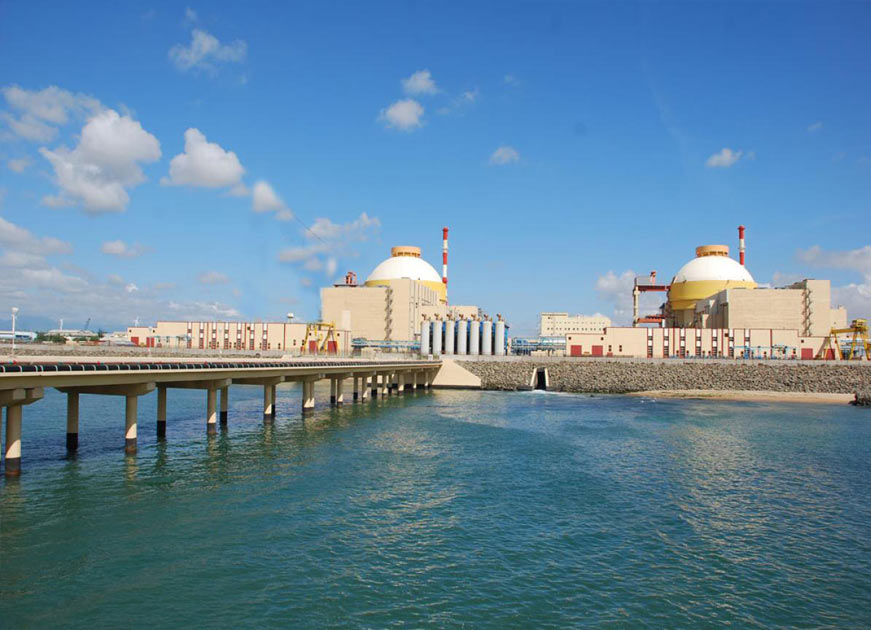
India is less constrained politically in dealing with Russia. Rosatom is building the Kudankulam project, supplies its fuel, and has discussed wider fuel-cycle cooperation with the Department of Atomic Energy. A long-term fuel contract for a Russian reactor is therefore plausible. However, fuel supply and fuel security are not the same. A reactor is purchased once, but fuel must be delivered throughout its operational life. With only one established supplier in the market, sanctions exposure, payment channels, shipping, insurance, and diplomatic relations all become operational reliability constraints. This does not make Russian supply inherently unreliable, but it does mean dependence must be priced and governed as a strategic risk, not treated as ordinary procurement.
Capability: An Unlikely Transfer
Fuels such as LEU and HALEU can be purchased, but enrichment capability is far less likely to be transferred. In 2011, the Nuclear Suppliers Group tightened its guidelines for transfers of enrichment and reprocessing technology. Such transfers were linked to conditions including membership of the Nuclear Non-Proliferation Treaty and comprehensive safeguards. India satisfies neither condition. New Delhi has maintained that its 2008 exemption should continue to govern civil nuclear cooperation, and major partners issued reassurances after the 2011 decision. Yet those assurances have not produced a transfer of enrichment technology. The prudent assumption, therefore, is that India may be able to buy HALEU and reactors suited to consume it, but should not expect to acquire the technology needed to reproduce foreign enrichment capability.
The prudent assumption, therefore, is that India may be able to buy HALEU and reactors suited to consume it, but should not expect to acquire the technology needed to reproduce foreign enrichment capability.
This distinction is central. Import dependence can be managed only if alternative suppliers exist. In the case of HALEU, such suppliers do not yet exist at scale. Domestic capability is therefore not a substitute that can be acquired later through negotiation; it would have to be created by the Indian state.
Standing: Rules that May Tighten
Moreover, HALEU sits within a non-proliferation debate that is reopening. The International Atomic Energy Agency has historically treated uranium below 20 percent enrichment as indirect-use material, while uranium at or above 20 percent is treated as direct-use material.
Some experts have argued that uranium enriched above roughly 12 percent poses greater weapons potential than current categories acknowledge. Not all experts agree. The American Nuclear Society has argued that these claims understate the engineering difficulty of weaponisation and overlook the record of safeguarded research reactors using similar fuel. Meanwhile, the United States National Nuclear Security Administration has supported further assessment while favouring adaptive safeguards over an automatic restriction.
India need not resolve this technical dispute to recognise the policy risk. Tightened safeguards, transport, or supply rules would affect India regardless of its position outside both the NSG and the Nuclear Non-Proliferation Treaty (NPT). And a state expanding enrichment capacity during a period of regulatory scrutiny would face demands for transparency and safeguards without a full role in writing the rules.
India should participate actively in IAEA discussions on HALEU safeguards, explain the civil purpose of any new capacity, and frame its renewed case for NSG membership around responsible fuel-cycle governance rather than status alone.
Therefore, diplomacy must begin before construction. India should participate actively in IAEA discussions on HALEU safeguards, explain the civil purpose of any new capacity, and frame its renewed case for NSG membership around responsible fuel-cycle governance rather than status alone.
The Domestic Choices Ahead
Against this backdrop, three domestic questions determine whether a HALEU option can exist:
First, India must decide whether future civil enrichment capacity will be placed under safeguards. Under the separation plan tabled in Parliament in May 2006, India designated a list of facilities as civilian and offered them for IAEA safeguards, excluding any facility judged relevant to its strategic programme. Enrichment facilities were kept outside that civilian list and remain unsafeguarded, so existing enrichment competence sits on the strategic side. A new civil facility intended to support imported reactors would need a clear safeguards status if foreign participation is to remain possible.
Second, enrichment alone is insufficient, and the framework that would support it does not yet exist. A working fuel chain also requires deconversion, fabrication for specific fuel forms, quality assurance, security categorisation, certified transport packaging, and a licensing regime. For material in the HALEU range, none of this is presently established in Indian regulation, which means that even a state-led programme would have no lawful route to production. These capabilities must therefore be planned together, since a gap at any single stage stops the chain regardless of how much enrichment capacity exists.
Third, and most consequentially, the rules must settle the enrichment question they presently leave open. Opening fabrication, conversion, and refining to private participation is the right direction, since these are the stages at which the Indian chain is thinnest and proliferation sensitivity is lowest. But the drafts set no assay limit. A private pathway should be capped explicitly at the conventional low-enriched band below five percent, with production in the HALEU range retained as a state function for the present. For a country outside the NPT, operating under a negotiated exemption and seeking NSG membership, licensing private entities to produce fuel in the HALEU band would invite precisely the scrutiny India has spent two decades working to avoid, and would complicate the civil-military separation on which international cooperation depends. A conservative threshold stated openly is nevertheless more useful than silence, which leaves domestic investors and foreign partners unable to plan.
Restricting enrichment in this way, however, carries an obligation. If only the state may enrich at these assays, then only the state can close the gap, and it must budget and schedule that capacity as a precondition of reactor approvals rather than as a consequence of them.
The immediate policy need is not commercial-scale HALEU production. Demand remains uncertain, and indigenous reactors may not require it. Instead, India should preserve the option deliberately. Accordingly, the government should take three steps. First, it should require a life-cycle fuel-security assessment before approving any imported reactor design. Second, it should decide the safeguards status of future civil enrichment capacity through a Cabinet process involving the Department of Atomic Energy, the Ministry of External Affairs, the Prime Minister’s Office, and the National Security Council Secretariat. Third, it should ensure that planned enrichment and fuel-fabrication expansion does not foreclose later HALEU production. The forthcoming notification should state the enrichment threshold explicitly and establish a HALEU regulatory framework, and the consultation closing on 4 September is the appropriate place to press the point.
India spent two decades securing access to the global nuclear market. By contrast, HALEU presents a different problem: access to reactors may be available, while access to the capability that fuels them may not be. If treated only as procurement, the issue will lead to long negotiations and durable dependence. Instead, it should be treated as a question of national capability, regulatory design, and strategic choice. Those decisions must be made at home before imported reactors make them unavoidable.
Kavya Wadhwa is a nuclear energy advocate and policy analyst dedicated to promoting sustainable energy solutions and driving policy reforms. His research primarily focuses on nuclear energy, nuclear security, and climate change.
The views expressed above belong to the author(s). ORF research and analyses now available on Telegram! Click here to access our curated content — blogs, longforms and interviews.