Aadhaar number. PAN card. Voter ID. Ration card. Sanichari Devi, 63, has packed all of these documents into a polythene bag for the special intensive revision (SIR) hearing at the Government Sarvodaya Bal Vidyalaya, a government school near Mori Gate in Delhi’s Chandni Chowk Assembly constituency on September 15.

These were the papers by which the State had recognised her, again and again, as a citizen all these years, she claims. But that afternoon they were not enough.
“First, the official at the hearing asked me to bring a bank passbook for which I had to return home,” she says. Home is about two kilometres away in an overcrowded Chandni Chowk locality. “When I came back panting, I was again sent another kilometre to get a photocopy of the documents,” she says on this errand alone.

“Tum log hai na padha likha toh bhi nahi bujha raha hai ki ka ka chahiye, hum toh hain hi angootha chaap, [You are all educated; even then you’re not telling us clearly what documents are needed. I am unlettered],” she says, distressed by the officials’ impatience and their cryptic responses.
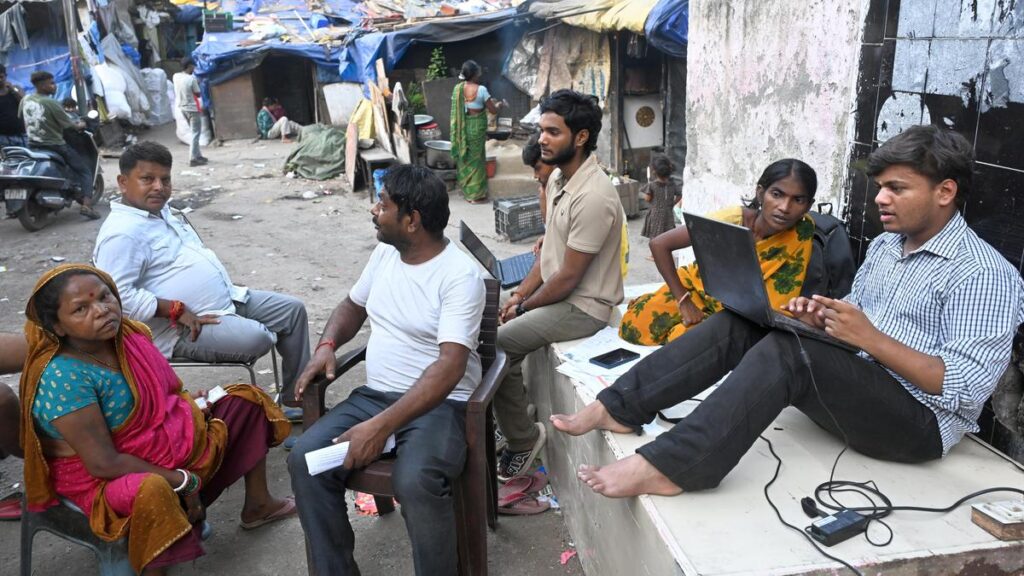
For nearly two hours, Devi, who claims her name was on the 2002 electoral roll in Bihar, where she was born, clutches her papers trying to understand the process of staying on India’s electoral roll. She is surrounded by 70 to 80 people, all with similar problems.
Devi is a daily-wage earner. Her ₹400-500 for the day is lost, and she has no idea how to pay for her family of three, including two grandsons. Her son and daughter-in-law are no more. Exhausted from walking and distressed from losing a day’s wage, Devi faints in the afternoon sun. Two men catch her before she falls and help her to a chair.

The government school in Chandni Chowk is one of the three locations in this Assembly constituency where SIR hearings are taking place. These hearings are for voters who had notices served to them for anomalies, like name mismatches, and for being unmapped — meaning their names or relatives’ names were not found on older SIR rolls.
At every hearing location, 100 to 1,000 people turn up every day with documents to prove that they are eligible to vote. Once they are there, many find that none of their documents match the 11 ID proofs prescribed by the Election Commission of India for the SIR. The exercise, rolled out in 2025 just before the Bihar Assembly election, was intended to clean up voter lists by identifying duplicate entries and removing the names of those who have died, moved from their addresses, or are illegal migrants. But since it was rolled out, and now having covered 30 of India’s States and Union Territories, over 13 crore people on the voter list have been removed during the draft stage. This has become the subject of intense public debate, with concerns that genuine voters are being left out, particularly those who struggle to navigate a documentation-heavy process.

The scale of deletions has been striking in Delhi. Of 1.45 crore people who were on the rolls on June 16, 2026, only 97.5 lakh remain. Around 47.6 lakh people have been marked Absent, Shifted, Dead and Duplicate (ASDD) as reasons for their exclusion at the draft stage. Of the 97.5 lakh on the list, more than one-third on the draft rolls face notices. These will be disposed of by October 29 after they submit their documents either online or at the hearing centres. The final roll will be published on November 4.
Physical and mental stress
At an SIR hearing centre in Rajouri Garden’s government boys’ school, the queue snakes past five rows of Booth Level Officers (BLOs) and Assistant Electoral Registration Officers (AEROs) seated at desks with laptops. Each family in the line carries a folder of documents collected over decades. Every day, around 500 cases are scheduled for hearing here.
Ram Chandar, 55, from Etah in Uttar Pradesh, has lived in Delhi for 37 years, working at a housekeeping service. He says he has voted during the tenures of Sheila Dikshit and Arvind Kejriwal, and in the last election when Rekha Gupta came to power. But this time, all his family members, including his parents, wife, brother, and sister-in-law, received notices stating that they had failed to provide details of themselves or a relative from the 2002 SIR rolls.

He is among more than 13.79 lakh people who have been served notices in Delhi after being marked “unmapped”; another 19.33 lakh were flagged for “logical discrepancies”, including name mismatches and age-related anomalies. Even after submitting his previous voter ID, his identification could not be established.
“They want illiterate people like us to provide such minute details that date back to 2002, while officials themselves are so careless that they sent me a notice for September 14, even though there was a UPSC and NDA entrance exam at this centre. If they cannot keep an account of a month’s calendar, how are we supposed to keep everything in place for years?” he says. His mother and sister-in-law, he says, would not be able to attend the hearing as they were in the village for a family function. “Will their names be deleted forever?” he wonders.
After a three-hour wait, when he climbs onto the stage where officials sit, the BLO takes barely a minute to answer his queries and sends him back with a list of additional documents to bring.

A few places behind him, Seema (name changed to protect privacy), 31, is helping her husband Rahul (name changed to protect privacy) navigate the same scrutiny. “Waise to tum logon ko unke kapdon se pehchaan lete hain; ab humein nahi pehchaan rahe ki hum tumhare desh ke hain ki nahi? [You can recognise people by their clothes, but now you can’t even recognise whether we belong to your country or not?]” she asks.
In 2019, Prime Minister Narendra Modi had said at a rally in Jharkhand (amid protests against the Citizenship Amendment Act, which was passed that year) that people could identify “aag lagane wale [arsonists]” by their clothes. In Rahul’s case, the only discrepancy was that his father’s name Mahavir was spelled “Mahaveer” on his voter ID. “They asked me to get this corrected and appeal for another hearing,” he says. If Ram Chandar and Rahul were undone by mismatched records, others were undone by the process itself.
Preeti Bora Mondal, 44, received a physical notice for a hearing on September 12, but missed it because of an official event scheduled a month earlier. “Now I got a notice over the phone for October 7. The notice reads that if I have any query, I can contact my BLO. But when I did, she never picked up,” she says. She adds, “They are serving us these notices as if we are criminals or have done something wrong.”

Most recipients didn’t know they could submit their documents online. The website link is available via a QR code on the notice.
Paramjeet Thukral, 55, who has recently moved to her parents’ home in Tagore Garden from south Delhi, says she did try to do everything online, but was unsuccessful as the system said she didn’t have the right documents. “I had attached everything which was needed,” she says, adding that if even half the time the government was spending on the exercise had gone into the city instead, “the roads would be better and the city cleaner.”
Manoj (name changed to protect privacy) and his family of five, who were also at the centre to respond to a notice, had received assurance that their enrolments would stand. His 80-year-old grandmother didn’t get this assurance, despite having voted in at least 10 State and Central elections. “So many illegal votes are cast in every election; they are not vigilant at that time,” he says. Seema, still nearby, is less measured: “Agli baar aane do inko vote maangne, tab bataayenge [The next time let them come asking for our votes; then we’ll teach them a lesson].” She is furious at the two-day wage loss her husband has suffered to get their names enrolled in the voter list and is worried about the cost of the Internet café and corrections still ahead of them.

“They want illiterate people like us to provide such minute details that date back to 2002, while officials themselves are so careless that they sent me a notice for September 14, despite the fact that there was a UPSC and NDA entrance exam at this centre. If they cannot keep an account of a month’s calendar, how are we supposed to keep everything in place for years?”Ram ChandarHousekeeping worker

Voters who received notices to prove their eligibility in the ongoing special intensive revision (SIR) queue at a designated centre with documents in New Delhi.
| Photo Credit:
Shashi Shekhar Kashyap
The confusion around documents
The AERO, Prabhas Kumar, who is attending to queries alone at Devi’s centre, says 7,000 notices had been generated at the centre comprising 50 booths of Chandni Chowk and BLOs are on the field to serve these notices to the people.
On the day Devi visited his station, he said that none of the people had the required documents. “But we are not turning them away. We are taking whatever they are bringing, from a Class 5 marksheet to a discharge card from the hospital where they were born,” Prabhas said, adding that even after maximum consideration, at least 50 people are turned away every day because they do not have a single valid document.
As per the ECI’s Standard Operating Procedure for the SIR, submitting only Aadhaar as a document is not sufficient.
Even though the 11 documents included educational certificates, this did not solve the problem for Yashoda Devi, 36. She sat restlessly outside the hall after being told that her Class 12 certificate, which she had spent a day looking for, would not be accepted because it did not mention her date of birth.
“I only have this. I don’t have a passport or a house in my name. My Class 10 certificate was destroyed when my parents’ house in Varanasi caught fire,” she says. Prabhas says a bank passbook could be attached as proof of date of birth, but he is unsure if it will be accepted.

In Rajouri Garden, several people say they are being asked to provide PAN cards. “I had my Class 10 CBSE marksheet and passport for age proof, yet the BLO kept insisting on a PAN card. When I resisted, saying it was not in the list of 11 documents shared with us, he took the marksheet,” says an attendee at the centre who did not wish to be named.
Electoral Registration Officer (ERO) Iti Agarwal, however, refuted the claim that PAN was being forced on people. “We are taking the PAN card as an additional document for proof of date of birth in cases where the elector has brought no document from those listed by the EC, or where the document provided is unsatisfactory. It is not mandatory since it is not a listed document,” she says. Even though hearings are scheduled in three time slots from the morning to 5 p.m., people in early slots end up waiting until the evening due to the lack of documents, and some return without a chance of hearing in a given slot. Their hearings are rescheduled.
Ader Khan, 52, has come directly from his daily-wage job in Wazirpur after taking half a day off with his wife, Heena Khan, for their 3-5 p.m. slot. However, when they asked for a token, they were turned away and told to come the next day or wait until 7.30 p.m.
“On one day, there are 300 people scheduled to attend a hearing. Not all show up. Of those who do, the desk can process only 120-130 cases due to a paucity of time,” says Kumar. As people surround the desk with their doubts, Kumar yells at a BLO who isn’t working at the centre but came for her own hearing. “You yourself don’t know what you have to do. It is because of this that so many people have been served notices. If BLOs had done their job properly, then all these people wouldn’t be standing here with their notices today.”
A BLO from North-east Delhi says the training was minimal and women, who have been appointed as teachers and now must do this work, are expected to go door to door. “How do you expect a woman to knock on a door when the smell of liquor reaches you even before the door is opened?” she says.

In West Delhi, a BLO complains that people living in kothis (bungalows) do not open their doors for them. She says she has sacrificed her brother’s wedding because of her work and leaves her newborn at home until 6 p.m. every day. “We serve notices through WhatsApp in that case,” she adds.
Digital rights activist Nikhil Pahwa, who was also served an SIR notice, says his experience at a hearing centre in central Delhi raises concerns over consent, communication, and the burden placed on voters.
“Officials directed applicants to write their mobile phone numbers on forms despite these being optional, raising questions about whether voter IDs were being linked to phone numbers without the voters’ consent. Also, whether consent was taken for photographing the voters,” he says, adding that he plans to file an RTI on the issue.
He adds that officials are rude, almost bullying people from underprivileged sections of society. At Rajouri Garden, an official yells at a woman wearing a salwar suit when she climbs onto the stage to ask when she would be called. She has been waiting for hours. “Get down, or I will lodge an FIR against you,” the official says, leaving the woman humiliated enough to leave the hearing.
Edited by Sunalini Mathew and Amarjot Kaur