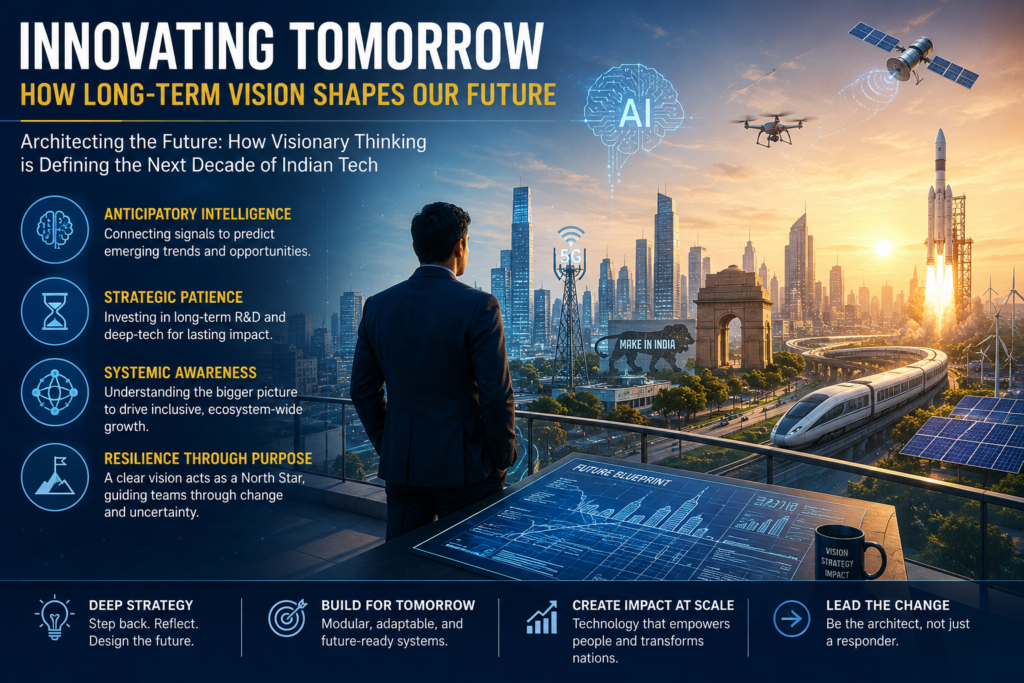
Architecting the Future: How Visionary Thinking is Defining the Next Decade of Indian Tech
In the rapidly evolving landscape of Indian technology, where market cycles are compressing and digital disruption is the new normal, the ability to “zoom out” has become the most critical asset for leaders and entrepreneurs. While daily operations and immediate bug fixes often dominate the boardroom, the real competitive advantage lies in the development of a future-focused vision. This mindset is no longer a philosophical luxury; it is a tactical necessity for companies looking to lead the next wave of innovation in India.
The Shift from Reactive Survival to Proactive Creation
In the traditional business model, success was often measured by reactive agility—how quickly a company could patch a problem or respond to a competitor’s feature launch. However, a new generation of visionary thinkers is shifting the focus toward “proactive creation.”
This involves mapping the terrain of the next decade rather than merely responding to the immediate pressures of the fiscal quarter. By adopting a “helicopter view” of the industry, these innovators are identifying emerging patterns in user behavior, infrastructure gaps, and regulatory shifts long before they hit the mainstream.
Core Pillars of a Future-Focused Strategy
For the Indian tech ecosystem to thrive, experts are emphasizing a framework that moves beyond traditional management. Based on modern industrial methodologies, this visionary approach relies on four key pillars:
- Anticipatory Intelligence: This is the capacity to connect disparate data points—ranging from semiconductor supply chain fluctuations to shifts in rural internet adoption—to predict emerging industry trends. It is the art of seeing the signal through the noise.
- Strategic Patience: In a startup ecosystem that often prioritizes rapid scaling and short-term valuation, strategic patience is the ability to commit to long-term R&D goals. This is essential for building deep-tech infrastructure that cannot be rushed, such as specialized chip design or sustainable energy grids.
- Systemic Awareness: Rather than focusing on isolated software modules, visionary architects are looking at the entire stack. This involves understanding how an individual digital payment app influences the broader financial inclusion goals of a nation, ensuring that growth is systemic rather than fragmented.
- Resilience through Purpose: A clear, long-term vision acts as a North Star. In volatile markets, this clarity allows technology teams to navigate pivots without losing sight of their core objective, preventing the “drift” that often leads to product obsolescence.
Implementing “Deep Strategy” in Tech Development
The transition to this mindset requires a structural change in how tech firms allocate their time. Many leading Indian tech organizations are now implementing “Deep Strategy” sessions. Unlike typical sprint planning or product review meetings, these are dedicated periods of reflection where the goal is specifically decoupled from current problem-solving.
During these intervals, leadership teams evaluate the trajectory of their entire endeavor. They ask critical questions: Will this technology still be relevant in five years? Is the current architecture modular enough to adapt to future breakthroughs? By consciously adjusting the cadence of thought—shifting from the granular to the structural—these organizations are positioning themselves to set industry standards rather than just chasing them.
Avoiding Obsolescence in a High-Velocity Market
The risk of remaining tethered to the status quo is currently at an all-time high in India. With the digital economy expanding into every sector, from agriculture to logistics, the cost of being “reactive” is professional and corporate obsolescence. Companies that prioritize only immediate demands find themselves at the mercy of platform shifts and market disruptions.
Conversely, those that adopt a forward-looking architecture become the architects of the market. They are not merely passengers in the unfolding narrative of India’s digital transformation; they are the ones writing the roadmap for the next generation of infrastructure.
Why it matters
For the Indian technology sector, the move toward future-focused, big-picture thinking is essential for long-term sovereignty and innovation. As India transitions from a hub of service-based delivery to a center of product-based innovation, building systems with long-term viability is the only way to ensure sustainable growth. By fostering a culture of anticipation and strategic patience, Indian tech firms can move beyond the trap of quick fixes and build robust, indigenous technologies that are designed to stand the test of time, ensuring the country remains at the forefront of the global digital economy.
Source: [source_domain]